An Old Fashioned is the best spirit-forward signature drink for an event because it batches better than almost anything else on a bar. Our house spec is 2 oz bourbon, 0.25 oz rich demerara syrup, 2 dashes Angostura and 1 dash orange bitters, batched with 20–22% water and refrigerated overnight. That turns a 45-second stirred cocktail into an eight-second pour — same drink, no bar line.
Every event menu we build has one spirit-forward drink on it, and more often than not that drink is an Old Fashioned. Not because it is fashionable — it has been on menus continuously for about a hundred and eighty years — but because of a practical fact most people never think about: the Old Fashioned is the most batch-friendly cocktail in the classical canon. No citrus to oxidize, no dairy to break, no egg white to shake, no carbonation to go flat. It is spirit, sugar, bitters and water, and those four things sit happily together in a bottle in a refrigerator for days.
This is our house spec, the variations we get asked for most, the math for scaling it to a real guest count, and the handful of ways it goes wrong at events.
A very short history (that actually changes how you make it)
The word “cocktail” first appears in print in 1806, in a New York newspaper, defined as “spirits of any kind, sugar, water and bitters.” That is the Old Fashioned. It did not have a name yet because it did not need one — it was the cocktail.
By the 1880s bartenders had begun dressing drinks up with liqueurs, vermouths and fruit, and older drinkers started asking for theirs made “the old-fashioned way.” The name is literally a complaint about menu creep. That history matters for one reason: the original has no muddled orange, no maraschino cherry mashed into the bottom of the glass, and no soda water. Those came from mid-century American bars working around bad whiskey. If your whiskey is decent, leave them out.
The practical takeaway for an event: a four-ingredient drink is a drink you can batch, and a drink you can batch is a drink that will not create a twenty-person line at your bar.
The La Barra Co. house spec
This is what we pour unless a client asks for something different. It is intentionally slightly drier and slightly stronger than the version most restaurants serve, because a sweet Old Fashioned gets cloying by the second one.
- 2 oz bourbon or rye, 90–100 proof. Below 86 proof the drink goes thin once diluted. Rye reads spicier and drier; bourbon reads rounder and reads better to a mixed crowd.
- 0.25 oz rich demerara syrup (2 parts demerara sugar to 1 part water, by weight). Rich syrup means less volume for the same sweetness, which means less dilution.
- 2 dashes Angostura bitters. Non-negotiable. This is the backbone.
- 1 dash orange bitters. Optional in theory, essential in practice — it is what makes people say “what is in this?”
- Expressed orange peel, wide swath, oils squeezed over the surface, then dropped in.
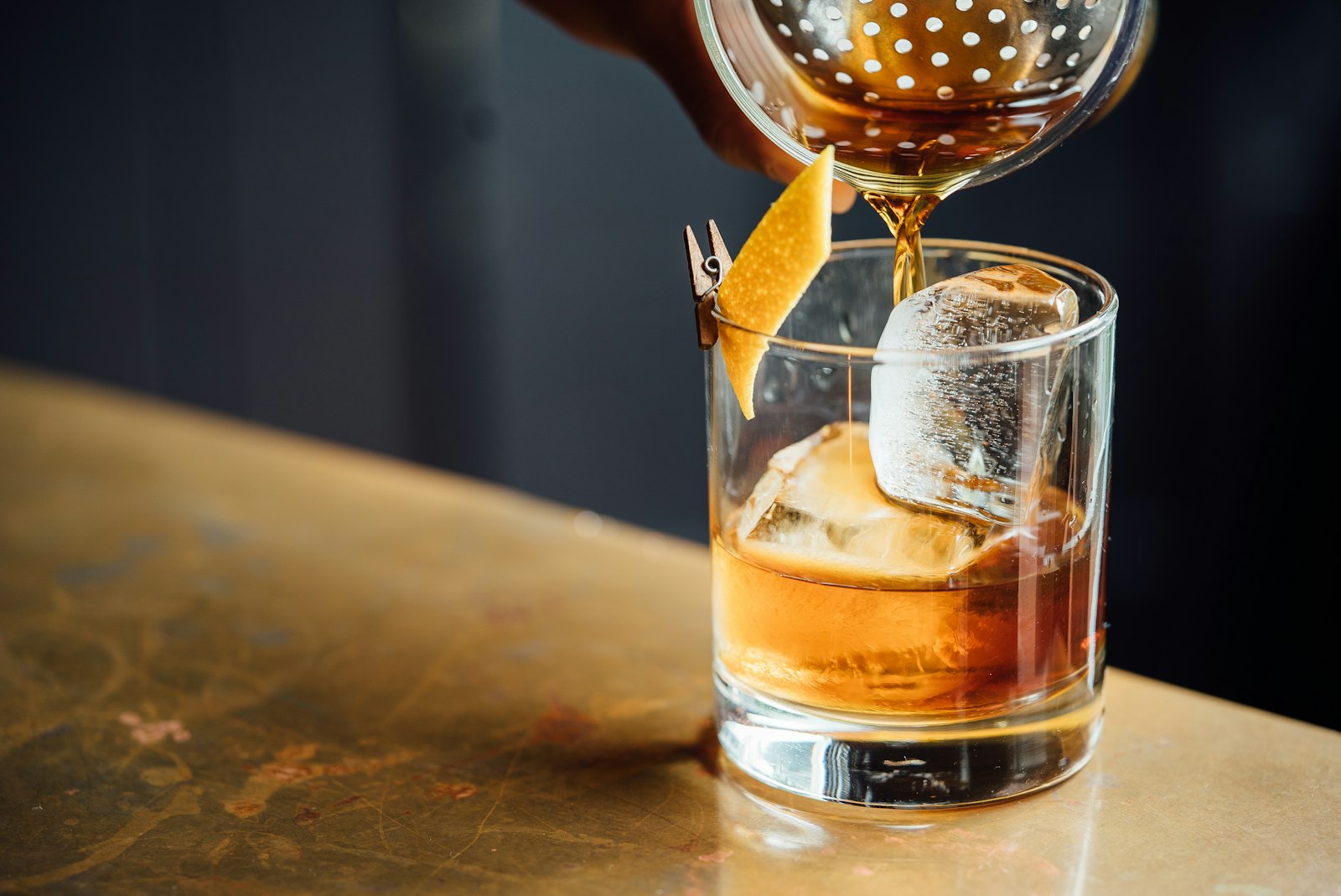
- One large cube. Not three small ones.
Stirred to order, that is about 45 seconds of bartender time per drink. Batched, it is eight. At 150 guests that difference is roughly an hour and a half of cumulative bar line, which is the entire reason we are writing this.
The batching spec, step by step
Stirring a cocktail does two things: it chills it and it dilutes it. When you batch, you replicate the dilution with measured water and get the chill from the refrigerator and the serving ice. The number that matters is 20 to 22 percent added water by volume. Less and the drink is hot and harsh; more and it goes flabby.
For a one-gallon batch (128 oz finished, roughly 56 drinks at 2.25 oz each):
| Ingredient | Amount per gallon batch | Notes |
|---|---|---|
| Bourbon or rye (90–100 proof) | 96 oz (about 1.5 handles) | 2 oz per drink × 48 drinks of base |
| Rich demerara syrup (2:1) | 12 oz | 0.25 oz per drink |
| Angostura bitters | 1.5 oz | Roughly 2 dashes per drink |
| Orange bitters | 0.75 oz | Roughly 1 dash per drink |
| Filtered water | 22 oz | The dilution — do not skip it |
| Rest time | 12–48 hours, refrigerated | The batch integrates and improves |
Bottle the batch in clean 750ml or 1L bottles rather than one giant container. Bottles chill faster, pour cleaner, and let you keep most of the batch cold in a cooler while only one bottle sits out on the bar. Label them. At the bar, the entire service motion becomes: large cube into the glass, pour 2.25 oz from the bottle, express the peel, drop it in, hand it over.
Garnish prep is the other half of the speed gain. Cut 40 to 50 orange peels in advance, wide swaths with a Y-peeler, and hold them in a covered container with a barely damp paper towel. Peels cut more than about six hours ahead lose their oils, so cut them the morning of, not the night before.
Get an instant quote
Tell us guest count and date — the founder texts back a real number, usually within the hour.
Four variations worth putting on a sign
The Oaxacan Old Fashioned
The most-requested variation we make, and the one that converts people who think they do not like Old Fashioneds. Split base: 1.5 oz reposado tequila, 0.5 oz mezcal, 0.25 oz agave nectar, 2 dashes Angostura, expressed orange peel. The mezcal is a seasoning, not the base — go heavier and the drink becomes a campfire. Batches identically to the original at 20% water.
The Mezcal Old Fashioned (full-smoke version)
For a crowd that already drinks agave: 2 oz mezcal espadín, 0.25 oz agave, 2 dashes Angostura, 1 dash mole or chocolate bitters, grapefruit peel instead of orange. Substantially more polarizing and substantially more memorable. If you put this on a menu, put a bourbon version next to it.
The Maple Rye (fall and holiday events)
2 oz rye, 0.25 oz Grade A dark maple syrup, 2 dashes Angostura, 1 dash black walnut bitters, orange peel. Maple carries a smoky-sweet weight that reads seasonal without being a novelty. This is our default spirit-forward pour for October through December holiday parties.
The Coffee Old Fashioned (late-night)
1.75 oz bourbon, 0.25 oz coffee liqueur, 0.25 oz demerara, 2 dashes Angostura, orange peel. Served in the last hour alongside a carajillo station, it does what a nightcap is supposed to do. Do not batch this one more than 24 hours out; coffee liqueur dulls.
How much do you actually need to buy?
Start from drinks, not guests. Our planning number for a five-hour reception is two drinks per guest in the first hour, then roughly one per guest per hour after — call it five to six drinks per guest across the night. Of those, about 60% are signature cocktails, and of the signatures, the spirit-forward option takes about 35%.
| Guest count | Old Fashioneds to plan for | Base spirit needed | Handles (1.75L) | Demerara syrup |
|---|---|---|---|---|
| 50 | ~90 | 180 oz | 3–4 | 24 oz |
| 75 | ~135 | 270 oz | 5 | 34 oz |
| 100 | ~175 | 350 oz | 6–7 | 44 oz |
| 150 | ~265 | 530 oz | 9–10 | 66 oz |
| 200 | ~350 | 700 oz | 12–13 | 88 oz |
Two things people consistently under-buy. Bitters: a 4 oz bottle of Angostura covers roughly 100 drinks, so a 150-guest event needs three bottles, not one. Ice: plan 2 to 2.5 pounds per guest total, and if you want large-format cubes for the Old Fashioned specifically, that is a separate order — standard bagged ice will not do it. We bring ice, mixers, garnishes, glassware and tools in every package, so in practice the only line above you are shopping for is the spirits, which is what dry hire in California means.
The five ways an Old Fashioned goes wrong at events
- Skipping the dilution water. The most common batching error by a mile. An undiluted batch poured over ice tastes hot for the first three minutes and watery after ten. Measure the water.
- Using granulated sugar or a sugar cube. Fine for one drink at home, disastrous at volume — undissolved sugar sits in the bottom of the glass. Syrup only.
- Muddling fruit. Muddled orange and cherry adds 30 seconds per drink and turns the batch cloudy if you try to pre-mix it. If a guest wants a cherry, drop one in.
- Small ice at an outdoor event. At a 3pm ceremony in Temecula or the Inland Empire, a drink built on small cubes is water in eight minutes. Large cube, or fill the glass completely.
- Only having the strong drink. An Old Fashioned is roughly 30% ABV in the glass. Without a lower-ABV option and a real non-alcoholic option, your guests will over-serve themselves by accident. Always pair it.
That last point is the one we push hardest on. Two signature drinks, one strong and one refreshing, plus a proper zero-proof option, is the configuration that keeps a room happy from cocktail hour through the last dance.
Putting it on the bar
If an Old Fashioned is your spirit-forward signature, three small decisions make it feel intentional rather than default. Name it — the neighborhood you met in, a grandparent's name, the street of your first apartment. Put three plain-English ingredients under the name on the sign, not the full spec, so guests can decide without reading a paragraph. And pick the whiskey deliberately: a wheated bourbon for a softer, rounder room, a high-rye bourbon or straight rye for a crowd that drinks whiskey already.
We run a menu call four to six weeks out, send an exact bottle-by-bottle shopping list three to four weeks out, and adjust it once your final headcount lands about ten days before the date. The 30-day checklist covers the rest of the timeline, and the birthday bar menu guide is where this drink shows up most often outside of weddings. We serve Los Angeles, Orange County, San Diego, Palm Springs and the Inland Empire — send a date and a guest count and you will get a real number back, usually within the hour.
Frequently asked questions
What is the best Old Fashioned recipe for a large event?
For events, use 2 ounces of 90 to 100 proof bourbon or rye, 0.25 ounces of rich demerara syrup, 2 dashes of Angostura bitters and 1 dash of orange bitters, then batch the whole thing with 20 to 22 percent water by volume and refrigerate it overnight. Batching pre-dilutes the drink so a bartender pours it over one large cube, expresses an orange peel and hands it over in about eight seconds instead of stirring each one for 45.
How much bourbon do I need for an Old Fashioned bar for 100 guests?
Assume about 35 to 40 percent of your drinks are the spirit-forward option, which for 100 guests over five hours is roughly 175 to 200 Old Fashioneds. At 2 ounces per drink that is 350 to 400 ounces of bourbon, which is 6 to 7 handles of 1.75 liters. Buy one extra handle since unopened bottles are returnable at most California retailers.
Can you batch an Old Fashioned in advance?
Yes, and it improves. A stirred, all-spirit drink like an Old Fashioned has no citrus or dairy to break down, so a batch made 24 to 48 hours ahead and kept cold actually integrates better than one stirred to order. Add 20 to 22 percent water to replicate the dilution you would get from stirring, then keep the batch refrigerated or on ice until service.
What is a mezcal or Oaxacan Old Fashioned?
An Oaxacan Old Fashioned swaps the whiskey for a split base of roughly 1.5 ounces reposado tequila and 0.5 ounces mezcal, uses agave nectar instead of sugar, and finishes with an expressed orange peel. It reads as smoky and slightly vegetal rather than sweet and oaky, and it is the single most requested variation we make at Southern California weddings.
What glass and ice should an Old Fashioned be served in at an event?
A 10 to 12 ounce rocks glass with one large cube or sphere. Large-format ice melts far slower, which matters at an outdoor Los Angeles or Inland Empire event where a small-cube drink turns watery in ten minutes. If large-format ice is not available, fill the glass completely with standard cubes rather than using two or three, because a full glass melts more slowly than a half-empty one.
Is an Old Fashioned too strong to be a wedding signature cocktail?
It is strong, which is exactly why it should be one of two signature cocktails rather than the only one. Pair it with a bright, lower-ABV refreshing drink like a paloma or a spritz. In practice the refreshing option outsells the spirit-forward one about 65 to 35, so plan your bottle counts accordingly.