One bottle of champagne pours six flutes at four ounces, so plan one bottle per five guests and add ten percent. Start pouring the toast at 11:45, not 11:58. Build the rest of the menu on two batched cocktails and one sparkling build so the bar can pour through the busiest four hours of the year without a line, and keep a real zero-proof option on the same board so nobody toasts with water.
New Year's Eve is the hardest night of the year to run a bar. Everybody arrives inside the same half hour, drinks steadily for four hours, and then wants a full glass in their hand at exactly the same second. There is no other event with two peaks that sharp.
Which is why the menu matters less than the mechanics. Here is both.
The champagne math, first
This is the number everyone gets wrong, and it is simple.
A standard 750ml bottle holds about 25 ounces. At a four-ounce toast pour that is six flutes per bottle. At a three-ounce pour, which is perfectly normal for a toast, it is eight.
| Guests | Toast only (4 oz pour) | Champagne served all night |
|---|---|---|
| 50 guests | 10 bottles | 17–25 bottles |
| 75 guests | 15 bottles | 25–38 bottles |
| 100 guests | 20 bottles | 34–50 bottles |
| 150 guests | 30 bottles | 50–75 bottles |
| 200 guests | 40 bottles | 67–100 bottles |
For a toast only, one bottle per five guests is the working rule. That gives everyone a proper pour plus refills for the third of the room who want a second. Add ten percent on top for breakage, over-pouring and the guests who arrive at 11:50.
On what to buy: for a large toast, a good cava or prosecco is the right answer. In a four-ounce pour that everyone drinks in one swallow while shouting, the difference between a $16 cava and a $60 champagne is essentially undetectable. If you want the real thing, buy six bottles for the hosts and the head table and pour cava for the room. That split saves several hundred dollars and no one has ever noticed.
The 11:45 rule
Pouring 100 flutes takes a trained bartender eight to ten minutes, working steadily, with the bottles already open and the glasses already out. Pouring 200 takes closer to twenty with two people.
So the toast pour starts at 11:45. Not 11:55, and definitely not at the countdown. The mechanics we run:
- 11:30 — flutes staged on trays behind the bar, bottles in ice, one bartender assigned exclusively to the toast.
- 11:45 — pouring begins. Trays go out to the floor rather than making guests come to the bar.
- 11:52 — a sweep of the room for anyone without a glass, including the people outside and the ones in the kitchen.
- 11:57 — zero-proof pours delivered to the guests who asked, same flute, same tray.
- 11:59 — bar stops taking orders. Everyone watches the clock.
- 12:05 — bar reopens. There is a rush; it is short.
Doing the toast by tray rather than at the bar is the difference-maker. If guests have to queue for their toast pour, the queue is still moving at 12:01.
Get an instant quote
Tell us guest count and date — the founder texts back a real number, usually within the hour.
The menu: three drinks, no line
Because demand is so concentrated, every drink on a New Year's Eve menu has to be pourable in under fifteen seconds. That rules out anything shaken to order or muddled per drink. Three builds cover the room.
1. The Batched French 75
The right New Year's Eve cocktail, and it batches beautifully if you split it. Pre-mix 1 oz gin, 0.5 oz fresh lemon juice, 0.25 oz simple syrup per drink into a single batch, keep it cold, then pour 1.75 oz of the batch into a flute and top with 3 oz of sparkling. Twelve seconds a drink, and it tastes like it was made to order because effectively it was.
2. Sparkling Pomegranate or Cranberry
Batch 1 oz vodka, 0.75 oz pomegranate or cranberry, 0.25 oz lime, top with sparkling wine or soda, garnish with a rosemary sprig and three pomegranate seeds. Deep red, photographs well against everything, and it is the drink the room orders most between 9 and 11.
3. Smoked Old Fashioned
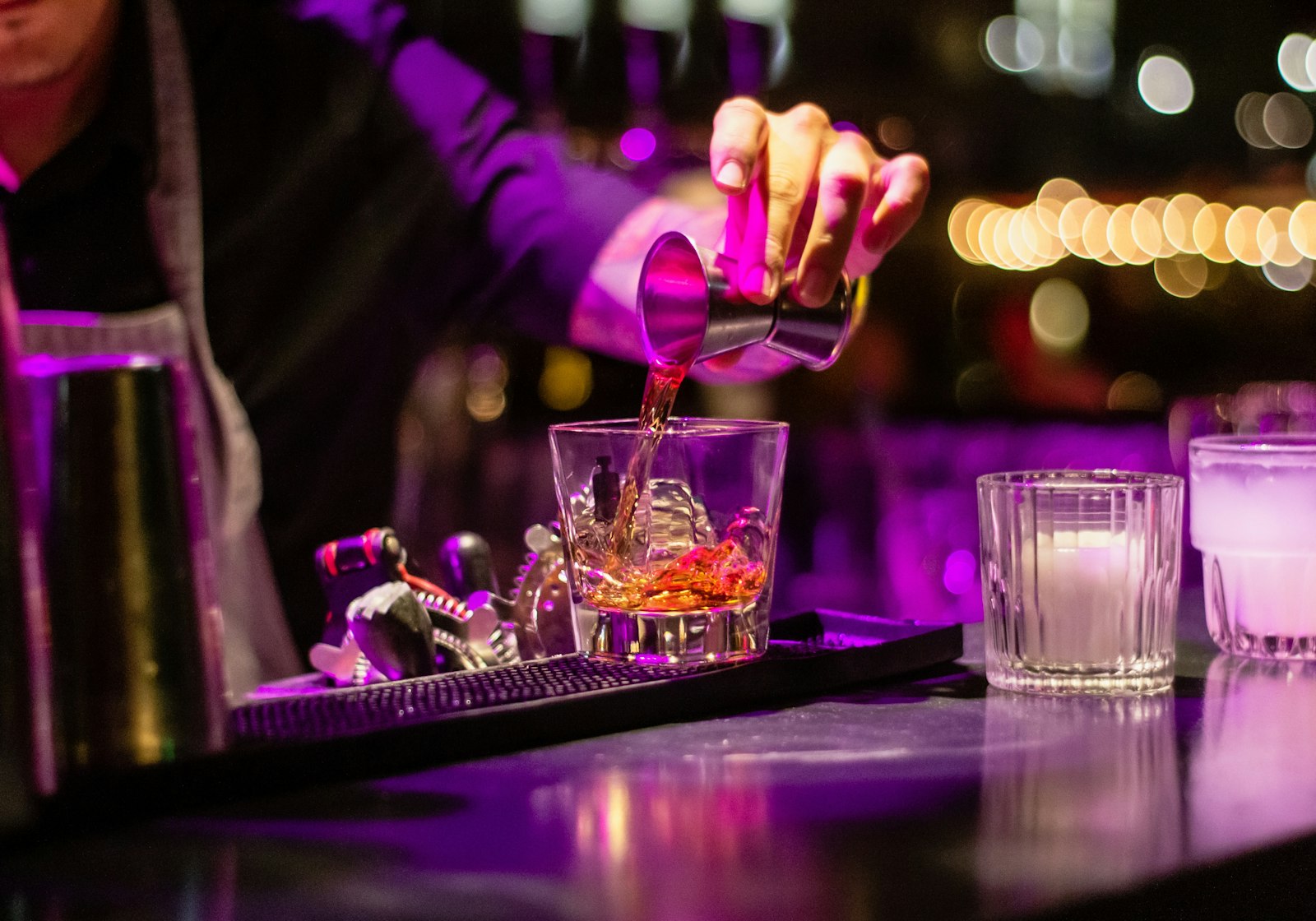
One spirit-forward option for the people who do not want anything sparkling. Batch it fully — 2 oz bourbon or rye, 0.25 oz demerara syrup, bitters — and pour over a large cube with an orange twist. If you want the smoke, do it in short runs of six glasses at a time rather than per drink; smoking one glass at a time at midnight is how a bar line becomes twenty minutes long. Our old fashioned guide covers the batching spec in detail.
4. The zero-proof one, on the same board
A sparkling non-alcoholic option with the same glass and the same garnish: 1 oz pomegranate, 0.5 oz lime, 0.25 oz ginger syrup, topped with sparkling water, rosemary and pomegranate seeds. And crucially, a zero-proof toast pour at midnight — a good non-alcoholic sparkling in the same flute. Nobody should toast the new year holding a glass of tap water. The full mocktail guide has nine more builds.
Quantities for 100 guests, all night
New Year's Eve runs longer than a normal party — typically 9 p.m. to 1 a.m. — but the drinking rate is not uniform. Guests drink hard in the first two hours, plateau, spike at midnight and slow sharply after. Our planning number is 5 to 6 drinks per guest across the night, higher than the 4 to 5 we use for a wedding.
| Item | 100 guests | Notes |
|---|---|---|
| Sparkling wine (cava/prosecco) | 30–35 bottles | 20 for the toast, the rest for cocktails and pours |
| Champagne (optional) | 6 bottles | Hosts and head table only |
| Gin | 3 handles | French 75 base |
| Vodka | 3 handles | Sparkling pomegranate and requests |
| Bourbon or rye | 2 handles | Old fashioned |
| Fresh lemon and lime juice | 1.5 gallons combined | Squeeze the morning of |
| Pomegranate / cranberry juice | 2 gallons | Cocktail and zero-proof base |
| Non-alcoholic sparkling | 8–10 bottles | Toast pours plus zero-proof cocktails |
| Flutes | 160–180 | 1.6–1.8 per guest; breakage is higher on NYE |
| Ice | 250 lbs | Included in every package |
| Water | 3 bottles per guest | Set up a self-serve station away from the bar |
Everything below the alcohol line — ice, mixers, garnish, glassware, tools, the bar and RBS-certified bartenders — comes with every La Barra Co package. You buy the alcohol at retail, we bring the rest, and there is no automatic gratuity.
Staffing and the two peaks
Staff New Year's Eve at one bartender per 40 to 50 guests, heavier than a normal party. The two peaks are the first hour and the twenty minutes around midnight, and both are unforgiving. For 100 guests: two bartenders, plus a third if you are running a single bar with limited rail space, because at some point the constraint stops being pouring speed and becomes how many people can physically stand at the bar.
Two other decisions that matter more on this night than any other. Food after midnight — something substantial at 12:15, even if it is simple, changes how the last hour goes and how everyone feels the next day. And rideshare planned in advance: December 31 has the worst surge pricing and the longest waits of the year, so a code, a designated area or arranged transport should be organised weeks ahead, not at 1 a.m.
Book it early. Really early.
December 31 is the most requested date on our calendar and it fills months out, usually by early autumn. If you are planning a New Year's Eve party in Los Angeles, Orange County or San Diego, treat the bar as one of the first three bookings you make. Send the date and a rough headcount and we will tell you immediately whether we can hold it.
Frequently asked questions
How many bottles of champagne do I need for a midnight toast?
A 750ml bottle pours six flutes at four ounces, or eight at three ounces. For a toast only, plan one bottle per five guests, which gives you a comfortable pour plus refills for the people who want one. For 100 guests that is 20 bottles for the toast. If champagne is also being served through the night rather than only at midnight, plan one bottle per two to three guests across the whole event.
What time should you start pouring the champagne toast?
Start at 11:45. Pouring 100 flutes takes a trained bartender roughly eight to ten minutes, and glasses need to be in hands before the countdown starts, not during it. Waiting until 11:55 means half the room is holding an empty glass at midnight, which is the single most common New Year's Eve service failure and it is entirely avoidable.
What cocktails work best for New Year's Eve?
Anything sparkling, and anything batched. A French 75 built as a batched base topped with sparkling wine, a sparkling cranberry or pomegranate cocktail, and one spirit-forward option like a smoked old fashioned cover the whole room. Avoid anything requiring a shake per drink or muddling to order, because New Year's Eve has the densest bar demand of any night of the year.
Should you serve champagne or prosecco for a toast?
For a large toast, a good cava or prosecco is the sensible choice. It costs a fraction of champagne, and in a four-ounce toast pour that everybody drinks in one go, almost nobody can tell the difference. If you want a real champagne moment, buy a small number of bottles for the head table or the hosts and pour cava for the room. That split saves hundreds of dollars and nobody notices.
How many bartenders do you need for New Year's Eve?
One per 40 to 50 guests, which is heavier than a normal party. New Year's Eve has two hard peaks — the first hour, when everyone arrives at once, and the twenty minutes around midnight — and understaffing shows up immediately at both. For 100 guests we would staff two bartenders and add a third if the format is a single bar with limited rail space.
When do you need to book bar service for New Year's Eve?
Earlier than any other date. December 31 is the single most requested date on our calendar and it typically fills months in advance, often by early autumn. If you are planning a New Year's Eve party, treat the bar booking as one of the first three things you do, alongside the venue and the headcount.